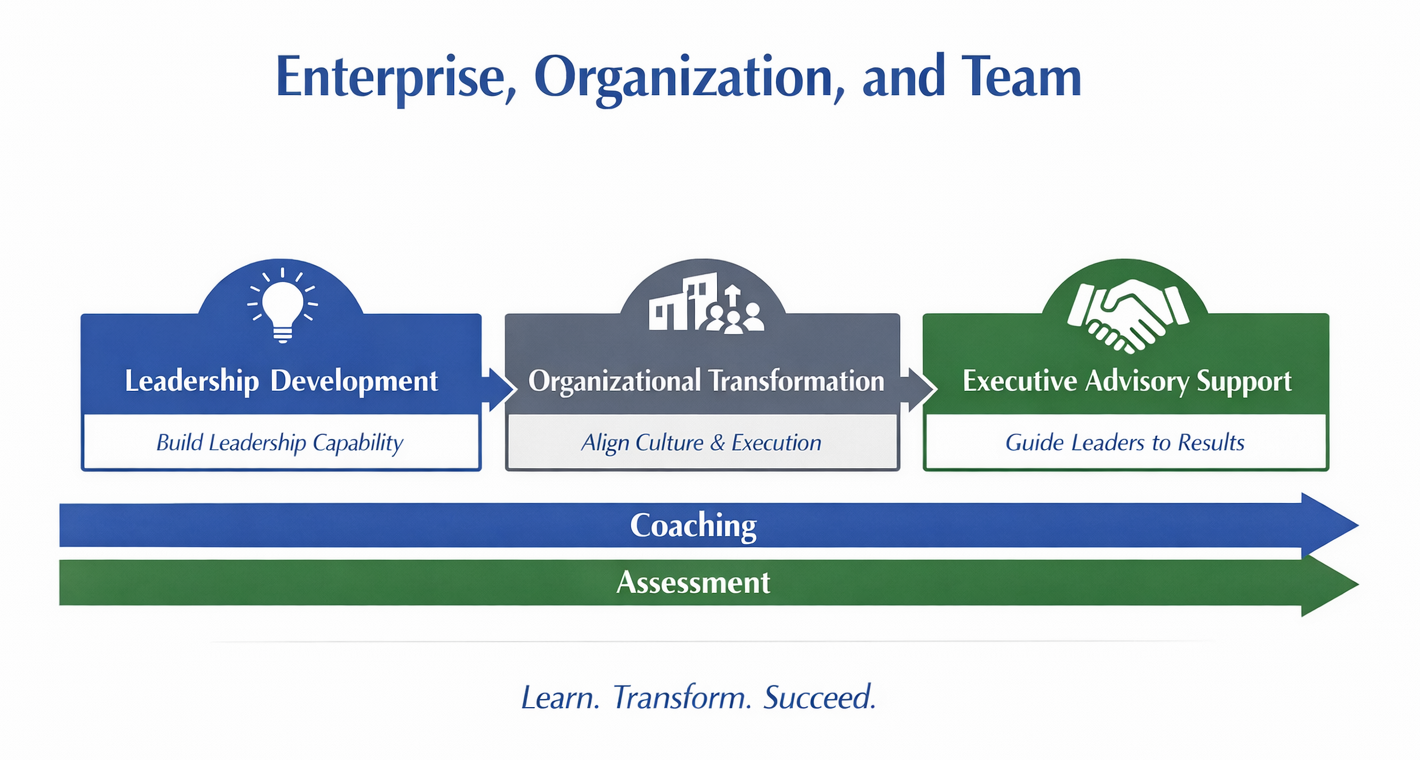
Enterprise Cohort‑Based Leadership Development
How the Cohort Leadership Development Pathway Is Structured
ILI’s cohort‑based leadership development is intentionally designed as a progressive pathway, not a set of disconnected programs. Leaders enter at the point that best matches their current role and scope—and continue to build capability as complexity and responsibility increase.
All cohorts share the same applied learning philosophy. What differs is depth, leadership level, and focus, not rigor or intent.
- Foundational and Tune‑Up Entry: Leaders who are newer to leadership—or experienced leaders seeking a focused refresh—begin by strengthening core leadership thinking and habits. These programs build a common foundation for sound judgment, clarity, and day‑to‑day leadership effectiveness.
- Core Leadership Foundation: Managers through Directors develop deeper self‑awareness, decision‑making capability, and relational effectiveness. Leaders learn to lead across functions, manage competing priorities, and apply leadership frameworks to real work through a structured, cohort‑based experience.
- Advanced and Enterprise Leadership: Senior leaders preparing for enterprise‑level scope deepen their ability to align self, culture, and systems. These programs focus on judgment under complexity, decision velocity, and leading at scale—often with assessment and coaching integrated to support readiness.
- Contextual Variations (e.g., AI Leadership): Some cohorts apply the same foundation architecture to specific leadership contexts, such as leading in AI‑enabled organizations. These programs add targeted content and dialogue while maintaining the same applied, cohort‑based learning approach.
- Coaching may support any stage of the pathway to accelerate learning, integration, and readiness as leadership demands increase.
Leaders may participate in a single cohort or progress through multiple cohorts over time as scope and organizational demands evolve.
Who is this Pathway For
This pathway is designed for organizations that want to:
- Build leadership capability across levels, not just at the top
- Create shared leadership language and expectations
- Improve decision quality, alignment, and execution
- Prepare leaders for expanded scope and increasing complexity
What Changes As a Result
Across cohorts, organizations see:
- Stronger leadership judgment and decision quality
- Greater alignment across leaders and teams
- More consistent leadership behaviors and expectations
- Improved ability to lead through change and ambiguity
- Leaders who apply tools immediately—not just complete training
How the Cohort Experience Works
All cohorts follow the same four‑part learning design:
How We Think About Measurement
We focus on practical indicators leaders recognize, such as:
- Changes in decision clarity and accountability
- Improved alignment and coordination across leaders
- Adoption of shared leadership tools and practices
- Evidence of application to real work and priorities
Choose the Right Cohort
Leadership Development Cohorts

Seven Mindsets Leadership — Feeder and Tune‑Up Cohort
Program summary
Who this is for
Best for (when to choose this)
Primary outcomes
Program structure
Curriculum overview
What’s included
How this connects
Ten AI Mindsets & Behaviors — Preparing Leaders to Lead AI Transformation
Program summary
Who this is for
Business challenge this curriculum addresses
Curriculum overview (11-session structure)
Delivery structure
Strategic impact
How this connects
Comprehensive Leadership Foundation Cohort: Build Capacity
Program summary
The Comprehensive Innovative Leadership Foundation is an advanced leadership development and succession-readiness experience designed for high-potential leaders and intact leadership teams preparing to assume broader enterprise responsibility. The curriculum is structured to accelerate leadership maturity, strategic judgment, and organizational impact in complex, volatile, and technology-disrupted environments.
This curriculum moves beyond skill acquisition to focus on the formation of leadership capability: how leaders think, decide, influence, and design systems under uncertainty. Participants are assessed on the quality, defensibility, and integration of their leadership judgments, not on participation alone.
Fully rebuilt in 2026 and delivered in two formats from a single curriculum — a facilitated cohort, and a one-to-one coaching format for leaders who need the same rigor on their own schedule.
Purpose and distinguishing features
This curriculum prepares participants to:
- Transition into higher-level leadership roles with expanded scope, ambiguity, and consequence
- Function as elite leadership teams capable of coordinated sense-making, decision-making, and execution across organizational boundaries
- Demonstrate measurable leadership maturity aligned to enterprise needs rather than personal style preferences
What distinguishes it is a single standard applied to every piece of work: a claim backed only by your own account is not yet defensible. Participants corroborate what they claim — a named observer, a number a third party could verify, a decision that actually happened. Each session produces an artifact, and every artifact from Session 3 onward is returned for revision against criteria participants can read before they submit.
Who this is for
- High-potential leaders preparing for expanded enterprise scope
- Cross-functional leaders strengthening decision quality and execution across boundaries
- Intact leadership teams seeking alignment, stronger judgment, and improved execution under pressure
- Succession candidates whose readiness the organization needs to be able to evidence
Learning philosophy
The curriculum emphasizes deeper self-knowledge as a leader of others and organizations, using assessment data as leadership intelligence to analyze patterns, evaluate constraints, and translate insight into observable leadership behaviors, system interventions, and organizational results.
Five instruments inform the work: the Position Success Indicator, completed at enrolment; the ILI Leadership Mindsets assessment with its self-scoring workbook; a developmental assessment tailored to this program and scoped to professional perspective; the ILI Resilience assessment; and an Executive Presence Model self-assessment. Results are used as patterns to analyze and constraints to work against, never as scores. Participants retake the mindsets assessment in the final session and compare against their own baseline.
Context the curriculum addresses
- Leadership under volatile, uncertain, complex, and ambiguous conditions
- Rapid technological change and AI-enabled work
- Shifting expectations of leadership authority, accountability, and influence
- Designing antifragile teams and organizations
Curriculum overview (module sequence)
The curriculum includes eight modules. Each module is explicitly limited to achieving defined learning outcomes; templates and reflections function as analytic tools to support diagnosis, judgment formation, and executive decision-making. Every module produces a working artifact or a numbered deliverable, and each opens against what the previous one produced.
Program flow (typical sequence)
|
|
Session |
What participants produce |
|
1 |
Foundations of Innovative Leadership |
A defensible definition of innovative leadership in their own context, VUCA-to-demand chains, and an initial development hypothesis |
|
2 |
Leading Self in a Changing System |
An evidence-based environmental scan, a constraint diagnosis, and one designed behavioral experiment |
|
3 |
Developmental Maturity, Vision, and Value Creation |
Vision and Maturity Integration Brief |
|
4 |
Sustaining Leadership Capacity: Strengths, Constraints, Resilience |
Leadership Capacity and Resilience Strategy Brief |
|
5 |
Development Plan and Strategic Communication |
Development Plan and Stakeholder Communication Brief |
|
6 |
Building Your Guiding Team and Navigating Conflict |
Leadership Support and Conflict Strategy Brief |
|
7 |
Taking Action Under Real Conditions |
Executive Presence and Visibility Risk Brief |
|
8 |
Embedding Change and Defending the Impact |
Executive Leadership Impact Portfolio, defended live to peers |
Delivery options
- Facilitated cohort delivery, typical cadence every three to four weeks. Each session runs three hours.
- One-to-one coaching format — the same curriculum and the same standard, delivered as paired sixty-minute sessions with evidence-gathering between them
- Customizable for leadership tiers
What leaders gain (learning outcomes)
By the end of the curriculum, participants will be able to:
- Define innovative leadership for their work context and justify when it outperforms other approaches under volatility and uncertainty
- Evaluate leadership effectiveness using diagnostic inputs and prioritize the highest-leverage development targets aligned to enterprise strategy
- Design an evidence-based leadership development plan with measurable behavior-change experiments aligned to next-role expectations
- Demonstrate advanced communication and conflict capability by planning and executing a high-stakes conversation that improves outcomes while preserving trust and accountability
- Build and defend a portfolio of executive artifacts that demonstrates leadership impact using credible indicators such as stakeholder feedback, decision quality, and execution results
Credential
Participants earn 60 Continuing Professional Education credits for qualified organizations. The program comprises 24 contact hours across eight three-hour sessions, plus 24 to 40 hours of applied work between sessions.
Certificate from the Innovative Leadership Institute and the Franklin University Mason Leadership Center.
What participation requires
Participants should expect to:
- Examine leadership through evidence, not intention
- Make and test leadership changes in real work conditions between sessions
- Receive challenge and support from a learning partner, peers, and facilitators
- Produce executive-level artifacts demonstrating readiness for greater responsibility
- Use AI within stated limits. Participants receive explicit guidance with worked prompts: AI may be used to test a draft against the published criteria, and not to supply the second view, the corroborating account, or the decision that happened. Participants are directed to the AI tools their organization provides.
Time commitment (out-of-class)
Out-of-class hours vary by session because the work does. Published so that leaders and their managers can plan.
|
Sessions |
Out-of-class time |
|
1, 2 and 6 |
2 to 3.5 hours |
|
3, 4, 5 and 7 |
3 to 5.5 hours |
|
8 |
6 to 8 hours — the capstone portfolio |
Sessions 3 and 8 are the two to plan leave and travel around. Deliverables are due two business days before the session that reviews them, except where the work depends on a conversation the session itself sets up. In addition, participants conduct active experimentation by applying leadership behaviors in their roles, supported by evidence-based thinking and peer accountability.
How this connects
Choose this curriculum when you want a rigorous leadership foundation that builds innovative leadership capability through mindsets, frameworks, and core practices. AI Mindsets for Leaders builds broad AI-readiness behaviors across levels; this Foundation develops deeper leadership maturity and judgment; the AI Leadership Cohort builds on this Foundation when leaders must apply learning directly to active AI transformation work.
Comprehensive Leadership Foundation in the Age of AI: Build Capacity
Program summary
Who this is for
Delivery options
Program design
Curriculum overview
Outcomes of this program
Credential
What leaders gain
How this connects
Advanced Leadership Development Program ALDP: Prepare for Enterprise Leadership
Program summary
Primary outcomes
The problem ALDP solves
What ALDP is (and is not)
Curriculum overview (9-session program flow)
How it works (curriculum design and learning model)
Who it’s for
What your organization gets
Program logistics and what’s included
Leadership Development Coaching and Advising 1:1 Support
Program summary
What this coaching is (and is not)
How the coaching works
What makes this coaching different
Outcomes leaders and organizations can expect
Who this coaching is for
How this connects
Executive Ally for Leadership Development
Program summary
The problem this program addresses
What this program is (and is not)
How the program works
What makes this program different
Outcomes leaders can expect
Who this program is for
How this connects
Organizational Transformation Cohorts

Organizational Transformation Leadership Development — Leadership, Culture, and Systems
Program summary
The problem this curriculum solves
What this curriculum is (and is not)
The curriculum is designed to help leaders:
This is not:
What makes this curriculum different
The curriculum is anchored in:
Curriculum overview (framework and modules)
Section 2: Foundational Framework (supplemental modules)
How the curriculum works
- Structured learning grounded in the ILI transformation framework
- Application to real, in‑flight transformation initiatives
- Curated learning resources that reinforce the framework
- Reflection and dialogue that translate insight into leadership action
Outcomes organizations can expect
- Clear alignment between strategy, leadership behavior, culture, and systems
- A shared transformation language and framework across leaders
- Stronger leadership capability to navigate complexity and resistance
- Improved execution on priority initiatives
- Reduced change fatigue through clearer focus, sequencing, and accountability
Who this curriculum is for
- Senior leaders and transformation sponsors
- Leadership teams are accountable for enterprise initiatives
- Organizations undergoing digital, operational, cultural, or strategic transformation
- Companies seeking a disciplined, leadership‑centered approach to change
How this connects
Organizational Transformation Coaching and Advising — 1:1 Executive Support
Program summary
The problem this coaching addresses
- Competing priorities and decision overload
- Resistance or misalignment across leadership teams
- Unclear ownership or inconsistent leadership behaviors
- Change fatigue and loss of momentum during implementation
What this coaching is (and is not)
- Apply the transformation framework to real, in‑flight initiatives
- Align leadership behaviors with strategic intent
- Navigate resistance, complexity, and organizational dynamics
- Translate insight into sustained execution and adoption
- Personal development coaching in isolation
- Therapy or reflective coaching without action
- A substitute for leadership development curricula
How the coaching works
- Regular one‑to‑one coaching and advising sessions
- Application of the Organizational Transformation framework to current initiatives
- Use of leadership and organizational assessments to clarify gaps and priorities
- Ongoing guidance to align people, process, and system changes
- Real‑time problem‑solving support as challenges emerge
What makes this coaching different
- Coaching grounded in a shared transformation framework
- Focus on enterprise outcomes, not individual insight alone
- Direct linkage between leadership behavior and adoption results
- Emphasis on disciplined execution and accountability
Outcomes organizations can expect
- Clearer leadership alignment and decision ownership
- Stronger adoption of strategic and operating model changes
- Reduced resistance and change fatigue
- Improved coordination across leaders and functions
- Greater confidence in navigating complexity and uncertainty
Who this coaching is for
- Transformation sponsors and executive leaders
- Senior leaders accountable for enterprise initiatives
- Leaders navigating complex, multi‑year change efforts
- Executives who need disciplined support during high‑stakes execution
How this connects
Executive Ally Program — Advising, Coaching, and Execution Support
Program summary
The problem this program addresses
- Operate across too many priorities at once
- Make high‑impact decisions with incomplete information
- Navigate resistance, ambiguity, and political dynamics
- Maintain momentum while managing execution risk
Without sustained support, even strong leaders experience decision fatigue, slowed execution, and fragmented follow‑through.
The Executive Ally Program addresses these challenges by providing continuous, high‑leverage support embedded in the leader’s real work.
What this program is (and is not)
How the program works
What makes this program different
Key differentiators include:
Outcomes leaders and organizations can expect
Who this program is for
How this connects
What to Expect
- Cohort‑based learning aligned to strategic priorities and enterprise initiatives
- Structured facilitation that converts learning into decisions, action, and results
- Shared leadership language and practices across functions and levels
- Tangible outputs that support execution beyond the program lifecycle
Ready to Get Started?
This page provides access and enrollment information for an Innovative Leadership Institute online program.
Learn more about Innovative Leadership